Tattoo images
Tattoo images, tattoo pictures, tattoo designs and tattoo photos - all this can be found on our website dedicated to tattoos.
Tattoo is a process of a permanent image application by punching or cutting the skin in the certain parts of the body together with injecting the coloring pigment under the skin. After this process, macrophage cells absorb the pigment to stop its spreading to the deeper layers of the skin. That explains an absence of an allergic reaction to the pigment.
It has historically been proven that the first tattoos appeared more then six thousand years ago within the primitive system. The tattoos were not just ornaments. They also were tribal, family or totem symbols. Those symbols indicated the social class of the person and moreover, they believed to have some magical powers.
The term ‘tattoo’ appeared in English due to a famous traveler James Cook, who mentioned it in the record of his journey to Polynesia in 1773. In translation from Tahitian dialect, ‘tattoo’ means a picture or an image. Cook was impressed by the tattoo art of Polynesian people. The Polynesian tattoos are the most ancient kind of tattoo designs. The technique and the character of the images were very close to the carved patterns that consisted of various elements and were known for the complexity of their design. Those carved patterns included some spirals, waves, winding ribbons and converging, diverging or straight lines. They refer to ritual, tribal and religious tattoos, that at the first place had totemic or protective meaning.
The tattoos designs, existing in Europe earlier didn’t have a particular name. Every nation had its own name for tattoos. They used as an ornament or as the way to identificate a human body. In the Western Europe, people used the words like ‘sign’, ‘imprint’ or ‘carved image’. People with tattoos were called ‘colored’ or ‘marked with a dotted line’. The process of a tattoo application was called ‘stabbing tattoos’.
The Cook’s term ‘tattoo’ that meant the same way of the decoration was not adopted at once. At first, it was connected only with a Tahitian tattoo. However, gradually this meaning was spreading within most of the European states. It found its place in different languages and filled a lexical gap, by giving the precise description of a thing referred above. The first time the word ‘tattoo’ get into the ‘Medical dictionary’ of a Belgian doctor P. Nysten in 1856. Later E. Littré included the world in the Dictionary of French language (Dictionnaire de la langue Française).
Types, styles and ways of application classify the tattoo designs. These characteristics are their distinctive features. The client, influenced by many circumstances, his way of life and some social traditions, chooses the type of the tattoo and its meaning.
We can divide tattoos according to the types of the images. There are permanent, temporary or mehndi and cosmetic tattoos. The permanent tattoos do not fade in the course of life. This is possible due to a special application by punching the skin with one or several needles with an injection of high-quality pigment. Such tattoos can be polychrome or monochrome.
The temporary or mehndi tattoos are not the actual tattoos. They last for about 4 weeks. Such tattoos consist of an image completed with the natural henna dye. You can apply them by using a brush, a metal or wood stick. The color of such image can vary from pink to dark brown and it depends on the dye components and a type of the skin. People widely use temporally tattoos in the East, India and South Africa.
The cosmetic tattoos are expected to last for 3 to 5 years. You can use them for eliminating some cosmetic defects ( hiding spots ) or for make-up ( lips or eyebrows tattooing). They are applied with a special henna-based solution that dissolves under the skin after some period of time will pass.
In addition, there are many main tattoo styles:
- Tribal is the most ancient tattoo style, that has come from Oceania and is represented by various patterns. Every tattoo design according to this style has its own meaning, and is regarded as amulet or talisman. Tribal patterns are usually done in black color. Also in modern tattoo images, this design is used for combination of complex tattoo pictures owing to specific black lines, that taper to end in a point.
- Celtic is an old style of tattooing, that has originated in Europe, namely in the Scandinavian countries , which inhabitants in ancient times were called Celtic. So, Celtic tat is one of the most favorite and widespread in the modern tattoo world. The secret of its beauty and expressiveness lies in the special ornamental design, elegant pattern which includes vegetative and animal elements, stylized druids knots, artful designs of various geometrical figures. Celtic tattoo images were initially represented by floral ornament. Then the set of tattoo design components was gradually enriched with some traditional elements, that were typical for other nations cultures, especially Slavs and Romans.
Celtic tattoo images amaze with intricate patterns that often cause bewilderment because of its complexity.
Quite often the combination of various Celtic tattoo elements looks like a real masterpiece.
The main distinctive feature of Celtic tattoo ornament is the abundance of loops, lines, spirals knots and crosses of a certain kind, that interweave with each other. Ancient Vikings were first, who got such tattoo images.
- Oriental is the ancient tattoo style which has come from the Asia countries (Japan, China, Laos, Burma, Vietnam, Nepal, India, Philippines). The main themes of this style are images of classic eastern dragons, fish (carps), symbols of water, flowers (lotus and chrysanthemum), sophisticated hieroglyphs, tigers, Buddha and Buddhist symbols, Sanskrit script.
The highlight of this style was the Japanese invisible tattoo image - "Kakushi-bori" (or hidden tattoo) which can be seen only in certain cases, such as during lovemaking or in a bath. Initially, it was intended that tattoo would cover as much body area as possible (the whole back, legs, parts of chest and abdomen).
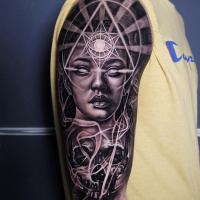
- Mystic tattoo is a long-standing style, the main elements of which are ancient magic symbols (Tantra, runes, pentacles, pentagrams, prayers), that are meant to arouse some feelings or conditions according to hidden sense of images (love, wealth, success, health, bravery, force). Also they are called « Karmic tattoos », as they are supposed to change karma (destiny).
-Tradition or Classic is not an old style, that’s characterized by quite primitive images of hearts, daggers, anchors, names, simple animal pictures, flowers, guns, card characters (aces, queens, jacks, kings) and other subject motives, sometimes even comic, whish are applied in order to show the passion for gambling or to complain of unrequited love.
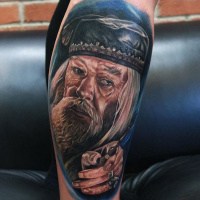
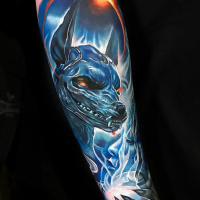
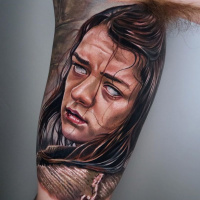
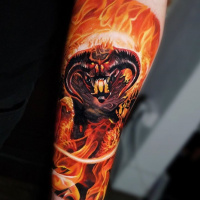
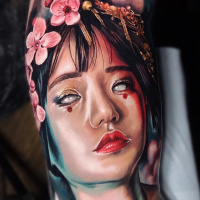
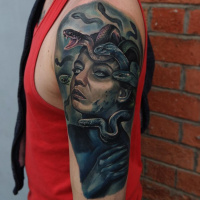
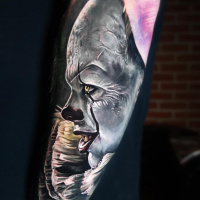
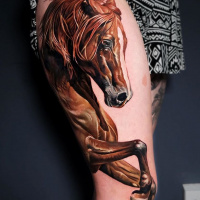
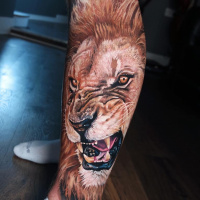
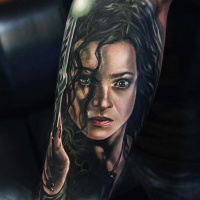
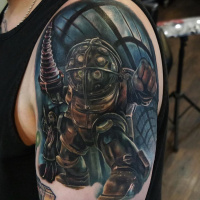
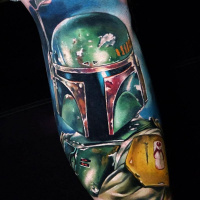
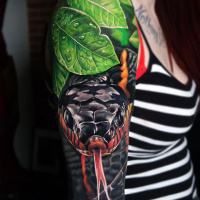
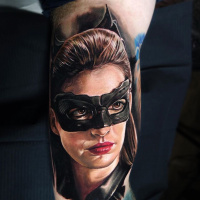
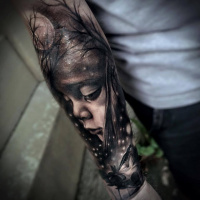
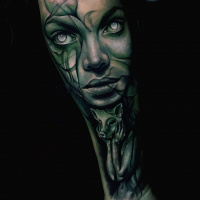
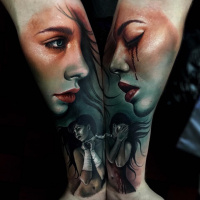
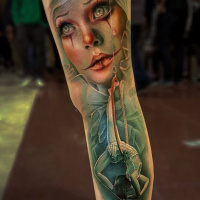
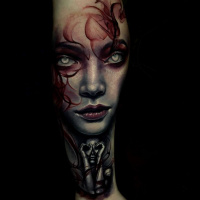
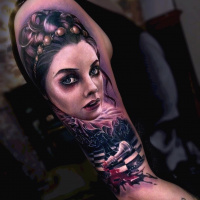
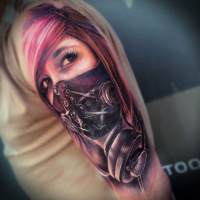
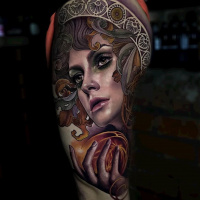
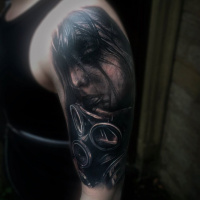
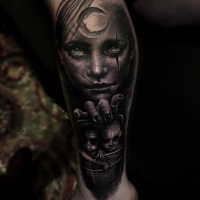
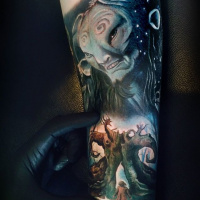
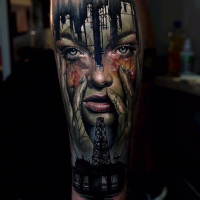
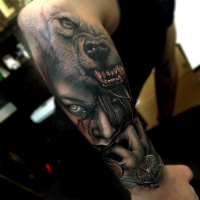
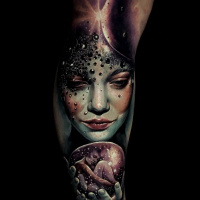
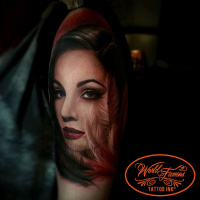
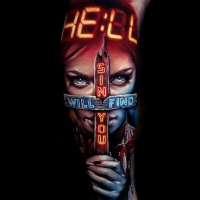
- Realism is rather new tattoo style in comparison with previous styles, that provides people, animal, insects, snakes, animals and other living beings images depicted with falling shadows, according to principles of similar painting style. Thus pictures look real and alive.
Today this style is one of the most spectacular and interesting tattoo styles, but it’s also the most complicated because of application technique, that requires very precise and realistic transferring of the image from the photo, portrait or picture on the client’s skin. That’s why, this tattoo is also called "photo on a body".
Below listed styles are very young and have begun to appear from the middle of XX century and up to now:
- Biker tattoos appeared simultaneously with the biker movement in the USA after the Second World War as its integral attribute. The term “biker” came from the English word “motorbike” and means a fan and admirer of motorcycles. Favorite themes of biker tattoo images are motorcycles, engines, brands of mototechnique manufacturers, symbols of clubs which they belong to, pictures of fire, fire-spitting dragons, skulls, predatory animals, mythical creatures, iron crosses and many other symbols and signs of bikers community. At that, the tattoo design is usually done in rather aggressive style. So better to say, that any tats, which have bikers, are considered done in biker tattoo style. So these images may have features of tribal abstraction, Celtic severity, Oriental exotica, Classic simplicity, Realism refinement and so on. There are no strict rules in biker tattoo applying, that’s why it seems as it combined various styles together with some bikers features.
Biker tattoo is not only the integral part of special subculture but also a new type of fine art, that includes body-art traditions, sacral talisman-symbols and real rock-painting.
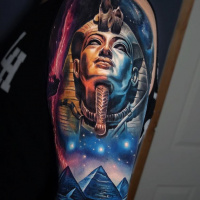
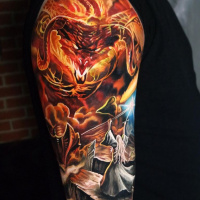
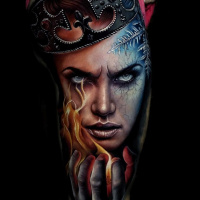
- Fantasy is represented by different images of monsters, unreal creatures that can be born both by darkness and light, sorcerers, mermaids, dwarves, elves, trolls, giants, ghosts, witches, phantoms, skulls, skeletons, bats - everything, that is associated with fantastic parallel worlds, which so close to us, and at the same time so far away.
The source of pictures for fantasy tattoo designs is fantastic literature of different genres, with its stories and characters. Persons who have such tattoos can be characterized as dreamy romantic with rich inner world.
- Biomechanics and High-Tech is almost the youngest style, but already very popular.
This style combines incongruous things, machinery details with details (parts) of living beings (biomechanics). For example, muscles can be depicted with wires and screws, tore skin with varied bones and gears sticking out of it. This tattoo style has appeared after the release of popular fantastic film "The Strangers", as its characters due to their uncommonness and extremality have inspired artists. This style of tattooing is normally done in dark colors, with accurate work on the details and shadow applying, but sometimes bright colors are also used.
A variety of tattoo styles isn’t limited by those, that were listed above. But in this article there were described the most popular and widespread tattoo styles that represent many cultural traditions of different nations, ethnic groups and social communities.
There several tattoo application methods, that differ from each other by application techniques, time consuming, intensity of pain sensation, that feel clients.
The main methods of applying tattoo images are:
- the first method: person with a tip of special needle, that is wounded by a thread or pishnya - the special tool that made of sharpened paper clip, wire or bracket from a school notebook needles the skin with small movements by picture outline and occasionally dips the tool into ink, which is inserted under the skin.
After that the image is retouched with a help of ballpoint pen color ink or crushed match sulfur. This method is primitive, time consuming, very painful and dangerous because of rather unsterile conditions. It is used in prisons, army, among street teenagers, in other words at places there no possibilities to get a professional tattoo.
- the second method: tattoo is applied with a help of special stencil, that is made of thick hard rubber piece which, in its turn, has sharp needles along the image outline. This ink wetted stencil is put on the body and with a heavy slap needles pass 0.3 -0.5 cm through the skin. This method is primitive, painful and time consuming as well.
- the third method: ink is injected under the skin by a special device, made on basis of the electric razor. This method is not very painful but is also time consuming and carries some risks to client health.
- the fourth method: the cuts in the skin along the image outline are made by blade and then coloring matter is rubbed into the wounds. The process of tattoo image applying according to this primitive method is not only very painful and time-consuming, but also poses a direct threat to client health and even life.
- the fifth method (mechanical): the tattoo picture is applied by a special device (induction or rotary machines) and special tattoo ink. Also in the image application process is used special tattoo stencil, that was chosen by the client. The tattoo is applied with a help of vibrating needles, that are attached to the bar of tattoo machine and by which the ink is injected into the skin. This procedure is rather painless and, that is also importantly, safe and sterile because the professional artists use disposable needles.
It is obvious that the first four primitive methods of tattooing are often used in the criminal world. The last fifth method, which is the most secure, is widely used in tattoo studios.
First inks that were used in ancient tattoos were derived from natural ground minerals, in particular, ochre, carbon black, coal, cinnabar, or mixture of these components. In the Middle Ages the powder mixture was used for tattooing. In our time, synthetic ink is widely used as it’s made in industrial way specially for tattooing and guarantees quality, safety, hypoallergenic, durability and stability (in terms of color).
There are also ways to remove the tattoo image:
mechanical method (dermabrasion) - is a way of skin resurfacing with a help of abrasive milling materials (rotary). It is used for small scale tattoos.
thermal method is the laser removal of permanent tattoos. Laser can also refine the small tattoo image defects.
chemical method (peeling) is supposed to remove the upper layers of the skin with particles of the coloring matter by exposure to chemicals.
Unfortunately, any of these methods don’t allow to remove the tattoo completely, as tattoo pigment is always below the renewing skin layers. So entirely get rid of the tattoo is only possible surgically by taking out a part of the skin. After the removal procedure, that surely have to be done by professional, the client need to undergo a long and quality treatment. So, before getting tattoo images, you should always think carefully about this step.
Everyone who wants to apply a tattoo on his body should remember that the tattoo image is a secret code that can provide both positive and negative effects on life. It’s always better to refuse the doubtful tattoos, if you don’t know its true meaning and can’t realize what harm it can cause.
As contraindications for tattooing can be various skin diseases such as eczema, psoriasis, dermatitis, abrasions and poor blood clotting.